
Tier-2 Expansion & Multi-City Scaling
Executive Overview
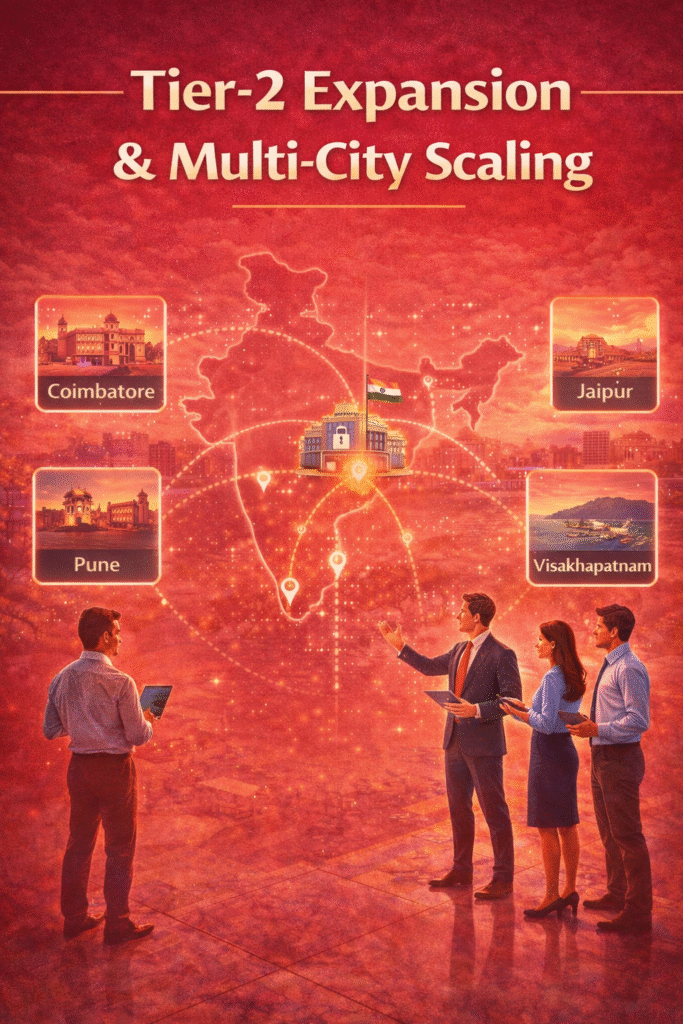
The Tier-2 Expansion & Multi-City Scaling Solution is designed to help Global Capability Centers (GCCs) scale beyond saturated Tier-1 hubs into Tier-2 Indian cities to unlock cost efficiencies, improve talent retention, and diversify delivery risk. This solution provides a structured, low-risk, and scalable approach to multi-city GCC expansion while maintaining governance, culture, and performance consistency.
This offering is highly relevant for:
- GCCs facing cost and attrition pressure in Tier-1 cities
- Mature GCCs planning Phase-2 or Phase-3 expansion
- Organizations seeking resilience through geographic diversification
1. Strategic Rationale for Tier-2 & Multi-City Expansion
1.1 Why Tier-2 Cities Now
- Escalating talent and real estate costs in Tier-1 cities
- Increasing attrition and leadership churn in large metros
- Maturing Tier-2 ecosystems with strong digital infrastructure
- Supportive state-level GCC policies and incentives
1.2 Strategic Benefits
- Lower operating and talent costs
- Improved employee loyalty and stability
- Access to untapped regional talent pools
- Reduced concentration and continuity risk
- Stronger employer brand in local ecosystems
2. Tier-2 City Landscape & Selection Framework
2.1 Tier-2 City Archetypes
Tier-2 cities are categorized based on maturity and capability fit:
- Emerging IT Hubs: Coimbatore, Indore, Trivandrum, Bhubaneswar
- Engineering & Manufacturing Talent Centers: Nagpur, Vadodara, Trichy
- Analytics & Support Talent Pools: Jaipur, Kochi, Ahmedabad
2.2 City Selection Framework
Cities are assessed across multiple dimensions:
- Talent availability and skill depth
- Cost of talent and facilities
- Ecosystem maturity (IT parks, universities, vendors)
- Infrastructure reliability
- State incentives and policy support
- Leadership and mobility feasibility
Output: Shortlisted cities aligned to GCC function mix
3. Multi-City GCC Operating Model Design
3.1 Hub-and-Spoke Model (Recommended)
- Tier-1 city as strategic and leadership hub
- Tier-2 cities as delivery and capability spokes
- Centralized governance with distributed execution
3.2 Alternative Models
- Dual-core model (two peer cities)
- Distributed delivery pods
- Virtual-first with physical anchors
3.3 Governance & Control
- Single GCC charter across locations
- Standardized KPIs, SLAs, and reporting
- Centralized financial and risk oversight
4. Workload & Capability Distribution Strategy
4.1 Suitable Workloads for Tier-2 Cities
- Application development and maintenance
- QA and test automation
- Product and customer support
- Data operations and analytics
- Shared services and back-office functions
4.2 Phased Capability Migration
- Phase 1: Execution-heavy, SLA-driven work
- Phase 2: Module ownership and advanced roles
- Phase 3: Specialized CoEs (select cities)
5. Talent Strategy for Tier-2 Expansion
5.1 Local Talent Engine
- Regional university partnerships
- Local hiring firms and community networks
- City-specific employer branding
5.2 Leadership & Culture Model
- Anchor leaders seeded from Tier-1 GCC
- Fast-track development of local leaders
- Unified culture, values, and performance framework
5.3 Retention Levers
- Location-stable career paths
- Clear progression and learning models
- Global exposure without forced relocation
6. Infrastructure & IT Enablement
6.1 Flexible Infrastructure Setup
- Managed offices and plug-and-play workspaces
- Scalable seat expansion model
- DR-ready and business continuity aligned
6.2 Digital Enablement
- Cloud-first workplace
- Secure remote access
- Unified collaboration and productivity stack
7. Risk, Compliance & Business Continuity
7.1 Risk Considerations
- Talent depth variability
- Leadership bandwidth
- Infrastructure reliability
7.2 Mitigation Framework
- Gradual ramp-up with clear thresholds
- Cross-city backup models
- Standardized compliance and security controls
8. Implementation Roadmap
Phase 1: Strategy & Feasibility
- City shortlisting and cost–benefit analysis
- Workload suitability assessment
- Leadership and operating model design
Phase 2: Pilot Launch
- Initial team setup in selected Tier-2 city
- Infrastructure and IT rollout
- Governance and reporting activation
Phase 3: Scale & Replication
- Expand headcount and capabilities
- Add second/third Tier-2 locations
- Integrate CoEs and advanced functions
9. Success Metrics
- Cost savings vs Tier-1 baseline
- Attrition and retention trends
- Time-to-hire and productivity
- Delivery quality and SLA adherence
- Leadership bench strength in Tier-2 locations
10. ApexGCC Value Proposition
ApexGCC enables enterprises to expand confidently beyond Tier-1 cities by combining ecosystem intelligence, operating model expertise, and execution rigor. This solution ensures Tier-2 expansion is not treated as a cost-only move, but as a strategic lever for sustainable GCC growth.