By Janardan Pendharkar
Today Software product companies are navigating an increasingly complex environment, shorter innovation cycles, rising customer expectations, cloud-native modernization, AI-driven roadmaps, and intense pressure to sustain engineering velocity without inflating costs. Traditional approaches to global delivery vendor-heavy models, contract teams, or fragmented offshore arrangements can only take organizations so far.
In contrast modern Global Capability Center (GCC) in India: a strategic, product-aligned extension of headquarters, purpose-built for innovation, engineering scale, and long-term value creation. According to NASSCOM, India now hosts 1,750+ GCCs, with nearly 40% focused on engineering, product development, analytics, or digital transformation work. McKinsey describes today’s GCCs as “innovation hubs powering enterprise transformation, not execution hubs of the past.”
For software product companies, the GCC model is no longer an experiment—it is increasingly becoming the playbook for building the future of product development.
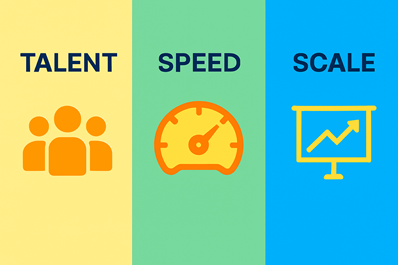
1. Talent: Building a Product-First Engineering Engine
a. Access to the World’s Deepest Product & Cloud Talent Pool
India’s rise as a product engineering powerhouse is grounded in talent availability. Zinnov reports that India has the largest pool of digital and deep-tech talent in the world, spanning full-stack engineering, SRE, cloud-native development, AI/ML, DevSecOps, and platform modernization.
A CTO of a mid-market US SaaS company recently reflected:
“We used to think of India as a place to extend capacity. Now we think of it as a place to build capability.”
The GCC model enables product companies to hire:
- full-stack and backend engineers with product thinking
- cloud architects, DevOps, and SRE specialists
- AI/ML practitioners
- QA automation and performance engineers
- product analysts and UX talent
This is the talent mix required to build modern software platforms not just maintain them.
b. Engineering Culture That Mirrors HQ
Modern GCCs work with:
- unified OKRs and product priorities
- the same SDLC, architecture governance, and security standards as HQ
- DevSecOps pipelines fully integrated with global systems
- local engineering leaders who understand product philosophy
Deloitte emphasizes this evolution, stating that today’s GCCs enable organizations to “extend culture, engineering discipline, and governance in a globally consistent way.”
For software companies that worry about “losing culture offshore,” this alignment changes everything.
c. Talent Retention and Institutional Knowledge
Vendor-based models often struggle with turnover, loss of context, and poor retention of tribal knowledge. In GCCs, long-term, employee-based teams stay, grow, and accumulate product expertise.
A CPO of a Bay Area SaaS firm said:
“Our India GCC became the memory of our platform. No outsourced team can replicate that.”
2. Speed: Driving Product Velocity, AI Experimentation, and Release Cadence
a. 30–40% Faster Innovation Cycles Through Distributed Product Pods
NASSCOM studies highlight a strong correlation between distributed R&D and shorter innovation cycles, especially for companies building cloud-native or AI-enabled products.
GCCs enable parallel execution by establishing cross-functional pods:
- AI/ML pods, modernization pods, QA automation pods & integration & API pods
These pods operate as extensions of HQ, accelerating release cadence while maintaining product quality.
b. Real-Time AI Experimentation Capacity
Software companies increasingly need rapid experimentation in:
- LLM-based product features
- ML-driven personalization
- computer vision, predictive analytics, semantic search, recommendations, and NLP
GCCs provide the talent density and scale required to run multiple experiments simultaneously.
A PE operating partner captured it succinctly:
“Without India, our portfolio companies cannot deliver AI at the speed the market expects.”
c. Strong Automation and DevOps Maturity
India has one of the world’s deepest concentrations of:
- test automation engineers
- performance engineering talent
- CI/CD architects
- cloud and DevSecOps professionals
McKinsey notes that leading GCCs drive enterprise-wide digital maturity, not just coding capacity. For product companies struggling with tech debt or release delays, these capabilities translate directly into velocity.
d. Round-the-Clock Engineering Without Burnout or Fragmentation
Unlike vendor models, GCCs create a unified operating construct where India teams and HQ teams work in a “follow-the-sun” rhythm on:
- incident response & reliability engineering
- code reviews, QA runs & deployments
This accelerates shipping without overloading the core engineering team.
3. Scale: Building a Sustainable, Predictable, Long-Term Product Engine
a. Scaling Without Onshore Cost Inflation
Onshore markets face:
- talent scarcity, high salary inflation & longer hiring cycles
GCCs let companies scale engineering without these constraints. Zinnov research shows that product companies in India scale engineering 2–3x faster compared to the US or Europe.
A software CTO shared:
“We doubled our engineering velocity by scaling pods through our India GCC. And we did it without doubling cost.”
b. Running Roadmap and Modernization in Parallel
Most mature SaaS firms are juggling:
- new feature demands & customer enhancements
- platform modernization & technical debt cleanup
- cloud migrations &security hardening
Without India-scale teams, these workstreams throttle each other.
GCCs make “parallel roadmaps” possible and sustainable.
c. Platform Stability and Reliability Engineering
Today’s product companies need faster MTTR, automated remediation, standardized observability, continuous performance tuning & secure SDLC workflows
India’s deep pool of SRE, cloud, and DevOps talent offers a significant advantage here.
McKinsey calls GCCs “resilience multipliers” for global engineering organizations.
d. Predictable Cost Curves (Key for PE-Backed Companies)
Software companies backed by private equity often face strict value-creation timelines. GCCs help them achieve:
- stable OPEX & fewer cost shocks
- predictable engineering investment
- higher EBITDA contribution
- scalable product throughput
A PE operating executive summarized it well:
“Vendor-based delivery improves output. GCC-based delivery improves enterprise value.”
4. The GCC Playbook: What Winning Software Companies Do Differently
Across our analysis and industry conversations, the most successful software product GCCs follow a consistent playbook:
1. Build around a Product-Pod Operating Model
Not ticket factories , but product owners, tech leads, architects, and cross-functional pods.
2. Start with a Strong Leadership Nucleus in India
Engineering managers, architects, SRE leads, and product managers embedded into global planning.
3. Focus Early on Automation, DevSecOps, and Quality
This unlocks speed and reduces long-term tech debt.
4. Integrate AI/ML Engineering from Day One
AI is no longer optional for any SaaS/tech company.
5. Mirror HQ Governance, Culture, and Security Standards
Unified engineering culture → unified product quality.
6. Use GCC Scale for Modernization & Innovation Not Just Overflow Work
GCCs that only do “extra work” stagnate. GCCs that own roadmap components thrive.
Conclusion: The GCC Is Now the Software Product Company’s Strategic Growth Engine
India’s GCC ecosystem is now recognized as the world’s strongest platform for building scalable, innovative, resilient engineering organizations.
As one SaaS founder put it:
“Our India GCC didn’t just make us faster.
It made us a better product company.”
*** END ***