
India GCC Entry Playbook
- Executive Summary
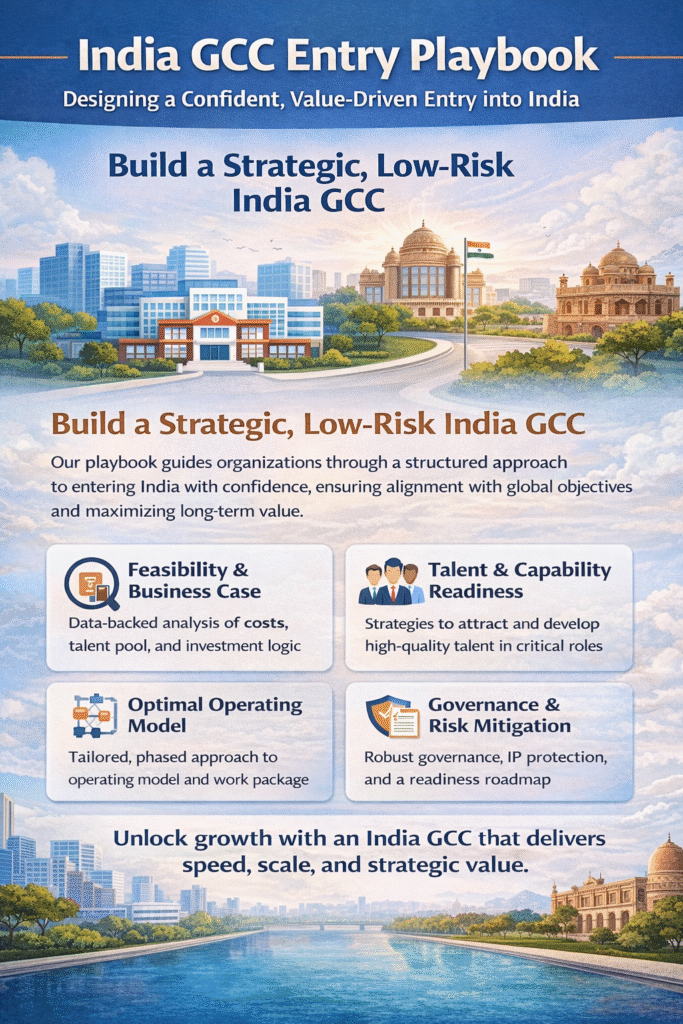
This India GCC Entry Playbook provides a structured, data-backed assessment to support an enterprise decision on establishing a Global Capability Center (GCC) in India. The playbook is illustrated using a hypothetical mid-sized global IT product company and evaluates strategic rationale, financial and operational feasibility, talent availability, work package suitability, operating model options, risks, and readiness.
The output is designed as a Board- and CXO-level decision document, supported by quantified benefits, phased execution logic, and a clear Go / No-Go recommendation.
- Strategic Context & Objectives
2.1 Hypothetical Company Profile (Illustrative – Mid-Sized Global IT Product Company)
- Company Type: Global IT / SaaS Product Company
- Annual Revenue: USD 200–400 million
- Employee Base: ~1,200–2,000 globally
- Core Products: B2B SaaS platforms (Cloud-native applications, Data platforms, Cybersecurity tools)
- Customer Base: North America & Europe (mid-enterprise and enterprise)
- Current Delivery Footprint: Predominantly US & Western Europe
- Strategic Challenges:
- Rising engineering and support costs
- Limited scalability of niche skills
- Dependency on high-cost onshore talent
- Pressure to accelerate product releases with constrained budgets
2.2 Business Drivers for India GCC Entry
- Achieve cost-efficient scale without compromising IP ownership
- Access high-quality full-stack, cloud, QA automation, and support talent
- Build a second delivery hub for business continuity
- Improve engineering throughput and release velocity
- Establish India as a long-term product engineering and support hub
2.3 GCC Objectives (Illustrative)
- Achieve 30–45% operating cost efficiency over 3–5 years
- Build a 250–450 FTE India GCC over 36 months
- Transition ownership of selected product modules
- Improve sprint velocity and defect resolution by 20–25%
- Market & Ecosystem Feasibility (Data-backed)
3.1 India GCC Landscape Snapshot
- ~1,700+ GCCs operating in India
- ~1.9 million professionals employed
- Strong presence across BFSI, Technology, Manufacturing, Life Sciences, Retail
- Shift from cost-arbitrage to capability- and value-arbitrage
3.2 Location Attractiveness Analysis
Tier-1 Cities: Bengaluru, Hyderabad, Pune, Chennai, NCR
- Pros: Deep talent, mature ecosystem, leadership availability
- Cons: Higher costs, rising attrition
Tier-2 Cities: Coimbatore, Kochi, Ahmedabad, Jaipur, Indore
- Pros: 15–30% cost advantage, improving talent depth, lower attrition
- Cons: Limited niche skills, ecosystem still maturing
3.3 Regulatory & Policy Environment
- 100% FDI under automatic route for most GCC-relevant sectors
- Strong central and state-level GCC policies
- Availability of SEZ, STPI, and DTA operating constructs
- Cost–Benefit & Financial Business Case
4.1 Cost Structure (Illustrative – % of Total Cost)
- Talent costs: 70–75%
- Real estate & facilities: 7–10%
- IT & tools: 5–7%
- Compliance, HR, finance & admin: 5–7%
- Leadership & governance overhead: 5–6%
4.2 Comparative Cost Analysis (Indicative Index)
| Location | Cost Index (US = 100) |
|---|---|
| US / Western Europe | 100 |
| Eastern Europe | 65–70 |
| India – Tier 1 | 45–50 |
| India – Tier 2 | 35–40 |
4.3 5-Year Financial Impact (Indicative)
- Annual steady-state savings: USD 8–12 million
- Breakeven period: 18–24 months
- Payback: <3 years
- EBITDA uplift potential: 6–10 percentage points
4.4 Strategic (Non-Financial) Benefits
- Faster hiring and scaling cycles
- Reduced dependency on niche onshore roles
- Improved release cadence and customer support SLAs
- Talent Feasibility & Capability Assessment
5.1 Talent Availability by Function (Mid-Sized Product Company Context)
| Function | India Talent Depth | Readiness |
|---|---|---|
| Full-stack Engineering | High | Ready |
| Cloud & DevOps | High | Ready |
| QA & Test Automation | Very High | Ready |
| L2/L3 Product Support | High | Ready |
| Product Management | Medium | Build |
5.2 Talent Cost Benchmarks (Indicative)
- Software Engineer (2–4 yrs): USD 18k–28k
- Senior Engineer / Tech Lead: USD 35k–55k
- Engineering Manager / Architect: USD 60k–90k
5.3 Key Talent Risks & Mitigation
- Brand pull vs large tech → Strong EVP, learning exposure
- Product knowledge ramp-up → Shadow teams, documentation
- Attrition risk → Clear career progression & ownership
- Operating Model Design Options
6.1 GCC Operating Model Options
- Lean Captive GCC – Fully owned, cost-efficient, IP-secure
- BOT (Accelerated Launch) – Partner-supported setup, phased transfer
- Hybrid Model – Captive core teams with partner pods for niche skills
6.2 Recommended Target Operating Model
- Lean captive GCC focused on product engineering, QA, DevOps, and support
- Flat org structure with strong engineering managers
- Tight integration with HQ product owners and architects
6.3 Phased Scale Plan
- Phase 1 (0–12 months): 50–100 FTE – QA, L2 support, DevOps
- Phase 2 (12–24 months): 150–300 FTE – Core modules, platform teams
- Phase 3 (24–36 months): 300–450 FTE – CoEs, advanced engineering
- Work Package Assessment (What Moves to India)
7.1 Work Package Suitability Criteria
Each work package is assessed on:
- IP sensitivity
- Customer impact
- Talent availability in India
- Transition complexity and documentation maturity
7.2 Illustrative Work Package Assessment (USD 200–400M Product Company)
| Work Package | Suitability | Phase | Rationale |
|---|---|---|---|
| QA & Automation | Very High | Phase 1 | Mature skills, quick ROI |
| L2/L3 Product Support | High | Phase 1 | SLA-driven, scalable |
| DevOps & Cloud Ops | High | Phase 1–2 | Strong India talent pool |
| Core Feature Development | Medium | Phase 2 | Needs product context |
| Platform Architecture | Medium | Phase 2–3 | Requires senior leadership |
| Product Management | Low–Medium | Phase 3 | Retain HQ-led initially |
7.3 Transition Philosophy
- Start with execution-heavy and SLA-driven work
- Gradually move ownership-based engineering
- Retain product strategy and roadmap at HQ initially
- Risk, Compliance & Governance Assessment
7.1 Key Risk Areas
- Regulatory & tax compliance
- Data security & IP protection
- Talent attrition
- Over-dependence on cost arbitrage
7.2 Governance Model
- Global GCC Steering Committee
- India GCC Leadership Council
- Clear RACI and escalation frameworks
- Readiness Scoring & Go/No-Go Model
8.1 GCC Readiness Dimensions
| Dimension | Weight |
|---|---|
| Strategic Alignment | 20% |
| Financial Viability | 20% |
| Talent Readiness | 20% |
| Operating Model Clarity | 15% |
| Risk & Compliance Preparedness | 15% |
| Leadership & Change Readiness | 10% |
8.2 Scoring Scale
- 1 = Low readiness
- 3 = Moderate readiness
- 5 = High readiness
8.3 Interpretation
- 80–100%: Proceed – High confidence
- 60–79%: Proceed with mitigation plan
- <60%: Defer / redesign entry strategy
- Implementation Roadmap (High-Level)
- Month 0–2: Detailed planning & approvals
- Month 2–4: Entity setup, location finalization
- Month 4–6: Talent hiring & infrastructure
- Month 6+: Go-live and scale
- Final Recommendation
For a mid-sized global IT product company with USD 200–400M in revenue, India represents a compelling and pragmatic GCC destination when approached with a lean, phased, and ownership-conscious model.
A lean captive GCC, starting with QA, support, and DevOps and expanding into core product engineering, offers the right balance of cost efficiency, IP protection, and scalability. With disciplined work package sequencing, strong governance, and early leadership investment, the India GCC can evolve into a core product delivery engine within 24–36 months, delivering measurable EBITDA uplift, faster releases, and long-term strategic resilience.