Building speed, scale, and reliability without compromising engineering excellence
By Janardan Pendharkar
Scaling product engineering, is one of the most complex challenges for modern technology companies. As SaaS, fintech, healthtech, logistics-tech, and industrial tech firms expand, they must increase feature velocity, strengthen platform resilience, adopt AI/ML, modernize architecture, and support global customers all while maintaining, or even improving, engineering quality.
However, scaling without discipline often leads to:
- inconsistent architecture
- fragmented codebases, poor test coverage & reliability gaps
- weakened culture, slower release cycles & erosion of customer trust
The key requirements for such scaling of engineering operations are:
- Availability of manpower trained in a range of areas – technology, business processes and management.
- Availability of worldclass infrastructure.
- A workforce that is energetic and has an aspirational work culture.
- Government policies that are supportive of global businesses.
- All the above, at a cost that results in substantial reduction in operating costs compared to other available options.
This is why many global technology companies and increasingly and more specifically PE-backed SaaS firms under value-creation pressure are turning to India-based Global Capability Centers (GCCs) as their strategic solution.
Industry analysts agree:
- Deloitte notes that modern GCCs act as “global centers of engineering rigor, governance, and innovation not cost centers.”
- BCG emphasizes that capability centers are now “critical to sustaining engineering excellence at scale.”
- EY reinforces that GCCs “improve quality by institutionalizing standards, metrics, and engineering governance.”
So how do the best companies scale engineering and maintain quality? Here are the lessons from top-performing GCCs.
1. Build a Leadership Nucleus Before You Build Scale
The most successful GCCs don’t start with large teams, they start with strong leaders:
- Engineering Managers
- Product Owners
- Architects
- SRE/DevOps Leads
- QA/Automation Leads
- Facilities, finance and legal compliance leads
A former CTO of a fintech scale-up shared:
“Once we had the right India leadership nucleus, the GCC became self-propelling. Quality actually improved as we scaled.”
This early leadership investment drives:
- cultural alignment
- engineering discipline
- architectural consistency
- mentorship for rapid hiring
- quality-first practices
It’s the #1 predictor of scaling successfully without compromising standards.
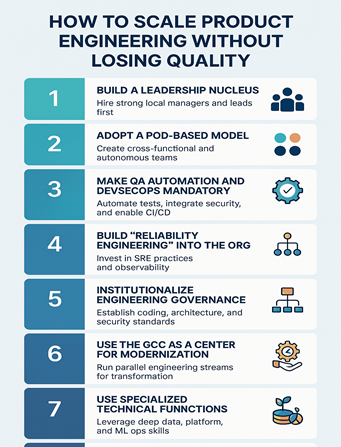
2. Adopt the Pod-Based Delivery Model Used by World-Class GCCs
Top GCCs run cross-functional, autonomous “pods”, not fragmented, ticket-based teams.
A well-designed GCC pod includes:
- A Product Owner
- Backend + Frontend Engineers
- QA Automation & DevOps/SRE support
- A UX/Design member
This model:
- increases accountability
- builds long-term ownership
- reduces handoffs
- enforces consistent quality
- accelerates cycle time
- supports parallel product streams
McKinsey notes that distributed pod models “increase quality and speed by minimizing functional silos.”
3. Make QA Automation and DevSecOps the Foundation of Scale
In traditional scaling models, QA suffers first.
Top GCCs avoid this by making automation and DevSecOps mandatory from Day 1.
This includes:
- automated regression suites & CI/CD with quality gates
- API and microservices testing & performance testing
- automated security scans & infrastructure-as-code for consistency
Zinnov highlights that India’s GCCs lead global enterprises in automation maturity, with QA automation coverage often exceeding 75–85%.
A SaaS VP of Engineering shared:
“Our India GCC automated more in 12 months than we did in four years. Quality issues dropped by 40%.”
4. Build “Reliability Engineering” Into the Org, Not After the Fact
Top GCCs invest early in SRE (Site Reliability Engineering) and observability frameworks.
High-maturity GCCs run:
- 24×7 incident response & SLO/SLA-driven reliability
- standardized monitoring & automated remediation
- observability dashboards & root-cause analyses embedded into sprint cycles
BCG writes that SRE-driven engineering hubs “significantly reduce failure cycles and elevate end-to-end product stability.”
This transforms reliability from reactive ops → a proactive engineering discipline.
5. Institutionalize Engineering Governance With a Global Architecture Council
Scaling engineering without governance leads to fragmentation.
Top GCCs avoid this by building:
- Architecture councils
- Guilds/chapters (DevOps, FE/BE, Data, SRE)
- Mandatory coding standards
- Architecture review boards & Security frameworks
- API guidelines, Design patterns and reusable components
Deloitte states that such governance structures “create engineering consistency across global teams.”
A PE Operating Partner remarked:
“Our GCC gave us the governance muscle we lacked. Within a quarter, tech debt stopped growing.”
6. Use the GCC as a Center for Modernization, Not Just Feature Development
Companies often struggle to modernize and build new features simultaneously.
Top GCCs run parallel modernization streams, such as:
- monolith-to-microservices
- API-first redesigns & cloud migrations
- improved observability & security hardening
- codebase cleanup & performance engineering
EY notes that GCCs “help accelerate modernization by dedicating stable, long-tenured teams to long-horizon engineering programs.”
This is critical modernization requires sustained commitment, not contractor turnover.
7. Use India’s Deep Talent Pool to Build Specialized Technical Functions
India’s GCC ecosystem now supports specialized roles such as:
- ML Ops,Data Engineering & Platform Engineering
- SRE, DevSecOps & Cloud FinOps
- Product Analytics & API Governance
NASSCOM highlights that India has the world’s largest pool of advanced digital engineering skills outside the US.
One SaaS engineering leader put it well:
“Our GCC became the place where deep engineering actually lived.”
These specialized capabilities elevate quality across the product stack.
8. Scale Through Culture Alignment, Not Just Hiring Velocity
Top GCCs maintain quality through culture replication, not just process replication.
This includes:
- embedding HQ values
- frequent leadership travel
- cross-location pairing & rotational programs
- global hackathons, shared sprint rituals & joint architecture reviews
McKinsey notes that successful global product teams share “common rituals, common tools, and common cultural norms.”
A CHRO of a global platform company reflected:
“The magic of our GCC is that it feels like our headquarters just with more talent.”
9. Make Metrics the Backbone of Quality at Scale
High-performing GCCs track:
Engineering Quality Metrics
- defect escape rate, code coverage
- MTTR & test automation coverage
- performance benchmarks
Velocity Metrics
- lead time for changes
- deployment frequency & cycle time per story
- predictability (planned vs delivered)
Reliability Metrics
- uptime, SLO compliance & error rates
BCG emphasizes that metrics-driven hubs “achieve higher consistency and superior customer experience.”
10. Build for Sustainability, Not Just Scale
The best GCCs focus on:
- stable teams & low attrition
- strong training programs & cross-functional growth
- mentorship and career paths
This builds institutional knowledge and protects quality over the long term.
Zinnov research shows that mature GCCs experience significantly lower attrition than traditional IT models because they offer richer, product-centric careers.
Summary : Scaling Without Losing Quality Is Possible, If You Build It Right
Top GCCs demonstrate that quality and scale are not opposing forces.
In fact, when engineered correctly, GCCs improve quality as teams grow.
The formula is clear:
- hire leadership first-organize around pods-embed automation & DevSecOps
- create architectural governance-build SRE and reliability muscle
- run modernization in parallel & use metrics to drive performance
- institutionalize culture & build long-term teams
Deloitte summarized it perfectly:
“The modern GCC is not an offshore center, it is a global center of engineering excellence.”
And as a CEO of a PE-backed SaaS company said after scaling through a GCC:
“Quality didn’t slip when we scaled.
It improved because the GCC made us a better engineering organization.”
*** END ***